

Dental emergencies have terrible timing. A crown comes off during dinner. A molar cracks on a popcorn kernel. A dull ache turns into throbbing pain that wakes you at two in the morning and will not respond to anything in the medicine cabinet.
In that moment, most people search for an Emergency Dentist In North Brunswick, NJ and hope someone picks up.
This guide answers the questions that come before that call. What actually counts as an emergency, what to do in the first fifteen minutes, when a hospital is the better choice, and what treatment looks like once you are in the chair.
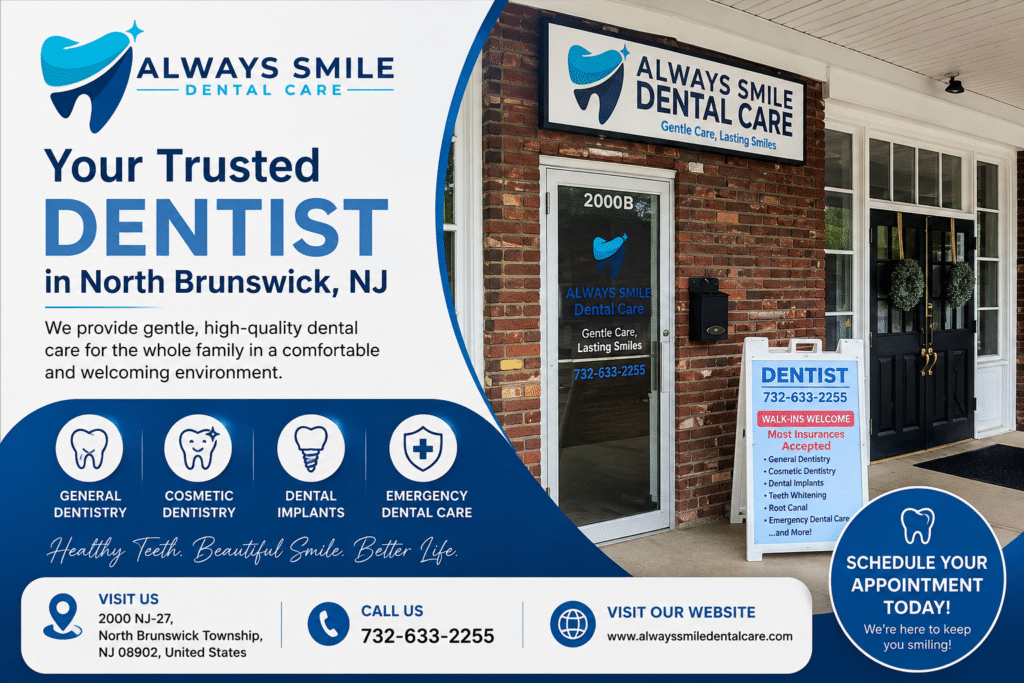
At Always Smile Dental Care, we keep time available for urgent cases and welcome walk-ins, because pain does not wait for the next open appointment.
Always Smile Dental Care, North Brunswick, NJ
- Address: 2000 NJ-27, North Brunswick Township, NJ 08902
- Phone: (732) 633-2255 | Walk-ins welcome
- Hours: Tue, Wed, Fri 10:00 AM to 5:00 PM | Sat 10:00 AM to 3:00 PM
- Dentist: Dr. Farida Fanuswala, DDS, NYU College of Dentistry
What Counts as a Dental Emergency?
A useful rule: if there is uncontrolled pain, active bleeding, swelling, or a tooth that has been knocked out or broken, it is an emergency and you should be seen the same day.
Anything that is uncomfortable but stable can usually wait for a regular appointment.
See a Dentist the Same Day For
- Severe or throbbing toothache that keeps you awake or does not settle with over-the-counter pain relief
- Facial or gum swelling, or a pimple-like bump on the gum, often a sign of a dental abscess
- A knocked-out permanent tooth, the most time-sensitive dental emergency there is
- A broken, cracked or badly chipped tooth, especially with pain or a sharp edge
- Bleeding that will not stop after an extraction or an injury
- A lost filling or crown leaving the tooth exposed and sensitive
- A loose adult tooth after trauma
- Something stuck under the gum that you cannot remove with floss
Usually Not an Emergency, But Book Soon
- Mild sensitivity to cold that settles within seconds
- A small chip with no pain
- Dull soreness after a recent dental procedure, easing day by day
- Food catching between two teeth
- Gums that bleed a little when you brush, worth a gum health evaluation but not urgent
When to Go to a Hospital Emergency Room Instead
Some situations are beyond what any dental office is equipped to manage.
Go to the ER or call 911 if you have
- Swelling that is spreading toward your eye or down your neck
- Difficulty breathing or swallowing
- Fever with facial swelling
- A suspected broken jaw or a significant facial injury
- Bleeding that will not stop with sustained pressure
For everything else, including pain, broken teeth, lost restorations and abscesses without spreading swelling, a dental office is the better call.
Hospital emergency departments generally cannot perform root canal treatment, place a filling, or repair a broken tooth. They can prescribe antibiotics and pain relief, then send you to a dentist anyway. Starting here saves you both time and money.
What to Do in the First Fifteen Minutes
What you do before you reach the office genuinely affects the outcome, particularly with a knocked-out tooth.
Knocked-Out Permanent Tooth
This is the one where minutes matter.
- Handle the tooth by the crown, the white chewing part, never by the root
- If it is dirty, rinse briefly with milk or saline, and do not scrub it or use soap
- If you can, place it gently back into the socket and bite softly on a clean cloth to hold it
- If reinserting is not possible, keep it in a cup of cold milk or in saliva, because plain water is a poor storage medium
- Call a dentist immediately, since reimplantation has the best outcomes within about an hour
A knocked-out baby tooth should not be reinserted, as that can damage the developing permanent tooth underneath. Still call, so the area can be checked.
Severe Toothache
- Rinse with warm salt water
- Floss gently around the tooth in case food debris is the cause
- Use over-the-counter pain relief exactly as directed on the packaging
- Apply a cold compress to the outside of your cheek for fifteen minutes at a time
- Sleep with your head elevated, because lying flat increases pressure and pain
- Do not place aspirin directly against the gum, since it burns the tissue and does not help
Persistent, spontaneous pain often means the nerve inside the tooth is inflamed or infected. That usually needs root canal treatment, which relieves the pain and saves the tooth.
Broken or Chipped Tooth
Rinse with warm water and save any pieces. Apply a cold compress for swelling.
If there is a sharp edge, cover it temporarily with orthodontic wax or sugar-free gum so it does not cut your tongue or cheek, and avoid chewing on that side.
Depending on how much tooth is lost, treatment may be a tooth-colored filling, a dental crown, or a veneer for a front tooth.
Lost Filling or Crown
Keep the crown if you still have it, because it can often be recemented.
Temporary dental cement from a pharmacy can protect the tooth for a day or two. Never use household glue. Avoid chewing on that side and get in promptly, because an exposed tooth decays quickly.
Swelling or Abscess
Rinse with warm salt water several times a day and use a cold compress on the outside of the face. Do not apply heat, and do not try to drain it yourself.
An abscess is a bacterial infection that will not resolve on its own. It needs professional treatment, usually root canal therapy, drainage, or in some cases extraction.
Same-Day Dentist, Regular Appointment, or Emergency Room
| Symptom | Where to Go |
|---|---|
| Knocked-out permanent tooth | Dentist immediately, within the hour |
| Severe pain keeping you awake | Dentist, same day |
| Gum swelling or an abscess bump | Dentist, same day |
| Broken tooth with a sharp edge | Dentist, same day |
| Crown or filling has come out | Dentist, within a day or two |
| Small painless chip | Dentist, regular appointment |
| Brief cold sensitivity | Dentist, regular appointment |
| Swelling spreading to eye or neck | Emergency room now |
| Trouble breathing or swallowing | Emergency room or 911 |
| Suspected broken jaw | Emergency room now |
If you are not sure which row you are in, call (732) 633-2255 and describe the symptoms. Our team will tell you honestly whether you need to be seen today.
Why Waiting Usually Costs More
Dental problems do not plateau. They progress, and each stage of delay narrows your options and raises your bill.
A cavity caught early is a filling. Left alone, it reaches the nerve and becomes a root canal plus a crown. Left longer, the tooth fractures below the gum and becomes an extraction, followed by a dental implant or partial denture to fill the gap.
The same logic applies to infection. An abscess contained around one tooth root is a manageable procedure. An infection that spreads into the surrounding tissue becomes a medical problem, not just a dental one.
Pain That Disappears Is Not Good News
When a badly infected nerve dies, the pain often stops for a while. The infection continues underneath, quietly, and moves toward the bone.
If you had severe pain that suddenly vanished, book an appointment anyway.
What to Expect at an Emergency Dental Visit
Emergency appointments are focused. The first goal is getting you out of pain, not completing every treatment in one sitting.
- Triage on the phone. Tell us what happened, where it hurts, and whether there is swelling, so we can prioritize your slot and prepare the room.
- Examination and X-ray of the affected area to identify what is actually going on.
- Pain relief first. Local anesthetic so the rest of the visit is comfortable.
- Immediate treatment. That might be opening a tooth to release pressure from an abscess, a temporary restoration, recementing a crown, smoothing a fracture, or beginning root canal treatment.
- A plan for what comes next, in writing, with costs explained before you agree to anything.
What to Bring
- Photo ID and your dental insurance card
- A list of current medications and allergies
- Any pieces of a broken tooth, or the crown that came off
If you are on blood thinners or have a heart condition, tell us before treatment begins.
How to Reduce Your Chances of a Next Time
Most true emergencies started as something a routine exam would have caught.
- Wear a mouthguard for sports. A custom guard costs far less than replacing a front tooth.
- Get a night guard if you grind. Clenching cracks molars slowly and silently, and our TMJ and night guard service covers this.
- Stop chewing ice, pens and popcorn kernels. These cause a surprising share of cracked teeth.
- Do not ignore small symptoms. Lingering sensitivity to hot or cold, a rough edge, or a tooth that aches when you bite are early warnings.
- Keep up with preventive visits. A routine exam catches the cracks and leaking fillings that turn into 2 AM emergencies.
Emergency Dental Care in North Brunswick Township
Our dental office at 2000 NJ-27 keeps time available for urgent cases and welcomes walk-ins.
Patients choose Always Smile Dental Care in an emergency for:
- Reserved same-day slots for urgent cases, plus walk-ins
- Saturday appointments from 10:00 AM to 3:00 PM
- Root canals, crowns, extractions and repairs handled in-house rather than referred out
- A written estimate before treatment begins, even in an emergency
- Insurance verified and claims filed for you
- Self-pay pricing, Cherry and CareCredit financing, and an in-office membership plan
- A calm approach for patients who are anxious or in a lot of pain
We are on the Route 27 corridor with parking on site, easy to reach from New Brunswick, East Brunswick, South Brunswick, Franklin Township, Milltown and Franklin Park.
Led by Dr. Farida Fanuswala, a graduate of NYU College of Dentistry, the practice treats urgent cases the way we treat everything else: explain what is happening, relieve the pain, then plan the rest.
Frequently Asked Questions
Is a toothache a dental emergency?
A toothache is a dental emergency when the pain is severe, wakes you at night, does not respond to over-the-counter pain relief, or comes with swelling or fever. Mild sensitivity that fades within seconds is usually not urgent, but it should still be examined. If you are unsure, call (732) 633-2255 and describe your symptoms, and our team will tell you whether you need to be seen today.
Should I go to the ER or a dentist for tooth pain?
See a dentist for tooth pain, broken teeth, lost fillings or crowns, and abscesses. Hospital emergency rooms generally cannot perform dental treatment. They can prescribe antibiotics and pain relief and then refer you to a dentist. Go to the ER or call 911 if you have difficulty breathing or swallowing, swelling spreading toward your eye or neck, a fever with facial swelling, a suspected broken jaw, or bleeding that will not stop.
What should I do if my tooth gets knocked out?
Pick the tooth up by the crown, never the root. Rinse it briefly with milk or saline if it is dirty, and do not scrub it. If possible, place it back into the socket and bite gently on a clean cloth. If you cannot, store it in cold milk or saliva rather than water, and get to a dentist immediately. The best chance of saving the tooth is within about an hour.
Can a dentist see me the same day for an emergency?
Yes. Our North Brunswick dental office reserves time for urgent cases and welcomes walk-ins. Calling (732) 633-2255 before you arrive helps, because it lets us prepare the treatment room and prioritize your visit. Office hours are Tuesday, Wednesday and Friday 10:00 AM to 5:00 PM, and Saturday 10:00 AM to 3:00 PM.
How much does emergency dental care cost?
Cost depends on what the tooth needs, and an emergency visit is usually billed as a focused exam plus an X-ray, followed by the treatment itself. We verify your insurance, file the claim for you, and give you a written estimate before any treatment begins. Cherry and CareCredit financing and self-pay options are available for patients without coverage. Call (732) 633-2255 to ask about your specific situation.
What can I do for tooth pain at night until I can see a dentist?
Rinse with warm salt water, floss gently around the tooth to clear any trapped food, and take over-the-counter pain relief exactly as directed on the label. Apply a cold compress to the outside of your cheek in fifteen-minute intervals, and sleep with your head elevated to reduce pressure. Avoid placing aspirin directly on the gum, and avoid very hot, very cold or sugary foods. These steps manage symptoms only, and the underlying cause still needs treatment.
Is a broken or chipped tooth an emergency?
A broken tooth is an emergency when there is pain, a large piece missing, bleeding, or a sharp edge cutting your tongue or cheek. A small painless chip can usually wait for a regular appointment, but it should still be checked, because cracks tend to spread. Repairs range from a tooth-colored filling to a dental crown depending on how much tooth structure is lost.
My tooth pain suddenly stopped. Do I still need to see a dentist?
Yes. When an infected nerve inside a tooth dies, the pain often disappears for a period even though the infection is still present and continuing to spread toward the bone. Pain that vanishes on its own after being severe is a warning sign, not a recovery. Book an examination promptly.
Can I wait until Monday if my tooth hurts over the weekend?
It depends on the symptoms. Mild discomfort that settles with over-the-counter pain relief can usually wait. Severe pain, facial swelling, fever, or a broken tooth with a sharp edge should be seen sooner. Our office sees patients on Saturday from 10:00 AM to 3:00 PM, so call (732) 633-2255 and describe what is happening rather than waiting it out.
Do you accept walk-in emergency patients without insurance?
Yes. Walk-ins are welcome and we treat patients with and without dental insurance. We offer self-pay pricing, Cherry and CareCredit financing, and an in-office membership plan. Call (732) 633-2255 or come to 2000 NJ-27, North Brunswick Township, NJ 08902.
How-To Guide: What to Do in a Dental Emergency
- Decide whether it is urgent. Uncontrolled pain, active bleeding, swelling, or a tooth that has been knocked out or broken should be seen the same day. Stable discomfort can wait for a regular appointment.
- Rule out a hospital emergency. Spreading swelling, trouble breathing or swallowing, fever with facial swelling, a suspected broken jaw, or bleeding that will not stop means the emergency room, not a dental office.
- Call and describe the symptoms. Say what happened, where it hurts and whether there is swelling, so the team can prioritize your slot and prepare the room before you arrive.
- Protect a knocked-out tooth. Handle it by the crown, rinse briefly with milk or saline without scrubbing, reinsert it if you can, and otherwise store it in cold milk or saliva. Aim to be seen within the hour.
- Control pain and swelling. Warm salt water rinse, gentle flossing, over-the-counter pain relief as labeled, a cold compress in fifteen-minute intervals, and sleeping with your head elevated.
- Protect a broken tooth or lost crown. Save the pieces, cover sharp edges with orthodontic wax or sugar-free gum, avoid chewing on that side, and never use household glue.
- Attend the appointment prepared. Bring photo ID, your insurance card and a list of medications and allergies, and mention blood thinners or heart conditions before treatment starts.
- Complete the follow-up treatment. Return for the permanent crown or the remaining stages of treatment so the temporary fix does not fail and the problem does not come back.
Final Thoughts
Most dental emergencies are far more manageable than they feel at two in the morning. The pain is frightening, but the treatment is usually routine, and the outcome depends mostly on how quickly you are seen.
The mistake that costs people teeth is waiting to see whether it settles. A knocked-out tooth has roughly an hour. An abscess spreads. Pain that stops on its own is often the worst sign of all.
If you have not yet settled on a regular practice, our guide on how to choose a dentist in North Brunswick covers what to look for. Choosing one before you need one is the whole point.
For same-day care from an Emergency Dentist In North Brunswick, NJ, call us and describe what is happening. The sooner we know, the sooner we can get you comfortable.
Need an Emergency Dentist in North Brunswick, NJ?
Do not wait out the pain. Call us, describe what is happening, and we will get you seen. Walk-ins welcome and most insurance plans accepted.
Call (732) 633-2255 Directions to Our Dental Office Request an Appointment
2000 NJ-27, North Brunswick Township, NJ 08902 • View our Google Business Profile
