

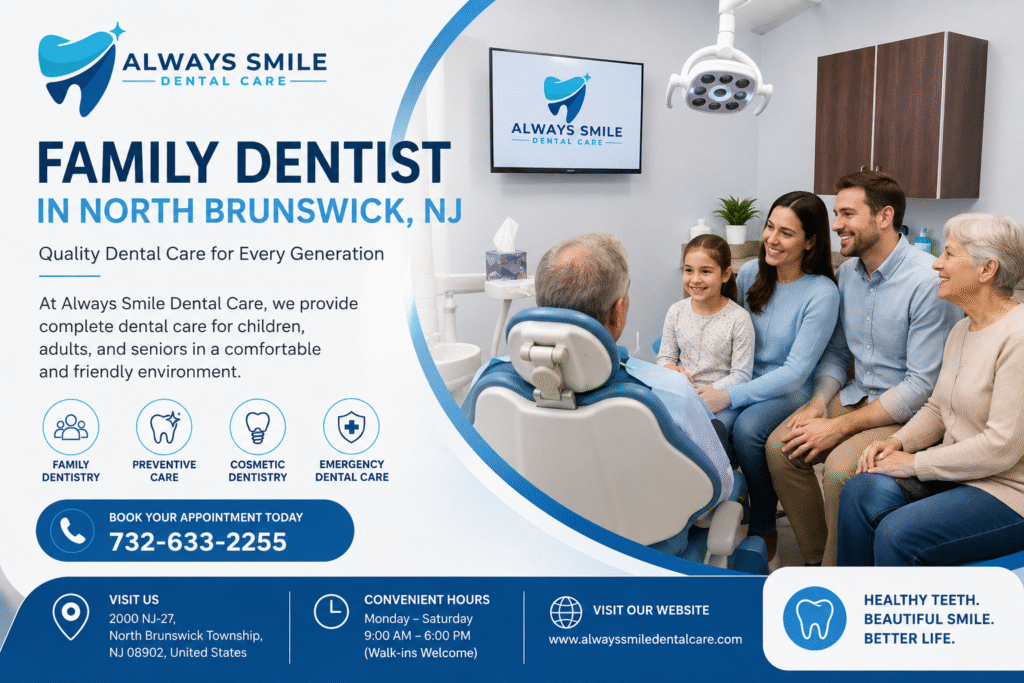
Managing dental appointments for a whole household is its own small logistics project. A six-year-old who needs sealants, a teenager in braces, two adults who are overdue, and a grandparent whose denture no longer fits, spread across three different offices in three different towns.
One Family Dentist In North Brunswick, NJ who treats every age simplifies that considerably. One set of records. One phone number. Appointments that can be stacked back to back on a Saturday morning instead of eating four separate afternoons.
At Always Smile Dental Care, Dr. Farida Fanuswala treats children, teens, adults and seniors under one roof. This guide walks through what dental care actually involves at each stage of life, and what to look for in a family dental office in North Brunswick Township.
Always Smile Dental Care, North Brunswick, NJ
- Address: 2000 NJ-27, North Brunswick Township, NJ 08902
- Phone: (732) 633-2255 | Walk-ins welcome
- Hours: Tue, Wed, Fri 10:00 AM to 5:00 PM | Sat 10:00 AM to 3:00 PM
- Dentist: Dr. Farida Fanuswala, DDS, NYU College of Dentistry
Ages 0 to 5: Building the Foundation
The recommendation from both the American Dental Association and the American Academy of Pediatric Dentistry is the same. A child’s first dental visit should happen when the first tooth appears, or by their first birthday, whichever comes first.
Most parents are surprised by that.
A first visit at age one is short and mostly about familiarity: a quick look at emerging teeth, a check of jaw development, and practical coaching for parents on brushing, bottles and pacifiers.
What Matters Most at This Stage
- Avoid bottles in bed. Milk or juice pooling around teeth overnight is the leading cause of early childhood decay.
- Brush as soon as the first tooth arrives, with a smear of fluoride toothpaste the size of a grain of rice.
- Start flossing once two teeth touch.
- Do not dismiss baby teeth. They hold space for the adult teeth behind them, and losing one early can push permanent teeth out of position.
The Benefit You Cannot Measure
Early visits build something that does not show up on an X-ray: a child who is not frightened of the dental chair.
That single outcome shapes the next fifty years of their oral health.
Ages 6 to 12: The Mixed Dentition Years
This is the stage with the most change. Baby teeth loosen, first permanent molars come in around age six, and the mouth becomes considerably harder to clean.
What Care Focuses On
- Dental sealants. A thin protective coating painted into the deep grooves of the back molars, where the majority of childhood cavities form. Application is quick, painless and requires no drilling.
- Fluoride treatments to strengthen developing enamel.
- Regular checkups and cleanings, usually every six months.
- Monitoring alignment and bite so orthodontic needs are identified at the right time.
- Sports mouthguards. Athletes without one are substantially more likely to sustain dental injuries.
Brushing Independence Comes Early
Children start taking responsibility for their own brushing at this age, usually before they are actually good at it.
Most children need supervision until around age eight.
Teens: Independence, Orthodontics and Habits That Stick
Teenage dental care is less about new procedures and more about consistency during years when routines slip.
Cavity risk rises with independent snacking and energy drinks, and orthodontic appliances make thorough cleaning harder.
Key Points for This Age Group
- Sports and energy drinks are acidic enough to erode enamel even without sugar. Water is genuinely better.
- Braces require extra cleaning tools. Interdental brushes and floss threaders are not optional.
- Wisdom teeth typically appear between 17 and 21. X-rays help determine whether they have room or need extraction.
- Appearance becomes motivating. Teens who dislike stained teeth often improve their habits quickly, and professional whitening is generally deferred until orthodontic treatment is finished.
Adults: Prevention, Repair and the Things People Ignore
Adults tend to fall into two groups: those who come every six months, and those who come when something hurts.
The gap between those two groups compounds enormously over twenty years.
Common Adult Dental Needs
- Routine exams and cleanings with oral cancer screening, because early detection matters most for the conditions with the fewest symptoms.
- Gum disease treatment. Roughly half of American adults over 30 have some degree of periodontal disease. Early stages are reversible, later stages are not, and it is the leading cause of adult tooth loss.
- Tooth-colored fillings for new decay or to replace old amalgam restorations.
- Crowns and bridges for cracked, worn or heavily restored teeth.
- Root canal treatment to save an infected tooth instead of losing it.
- Dental implants to replace missing teeth and preserve jawbone.
- Night guards for grinding, a habit most people only discover after a molar cracks or their jaw starts aching.
- Cosmetic work such as whitening, veneers and bonding.
One Point Worth Stating Plainly
Bleeding gums are not normal. Healthy gums do not bleed when brushed.
If yours do, it is worth an appointment.
Seniors: Keeping Natural Teeth and Adapting to Change
Older adults keep more of their natural teeth than any previous generation, which brings its own set of needs.
What Changes With Age
- Dry mouth from medication. Hundreds of common prescriptions reduce saliva, and saliva is the mouth’s main defense against decay. Dry mouth raises cavity risk sharply, particularly around the roots of teeth.
- Root decay. As gums recede, exposed root surfaces decay faster than enamel.
- Denture care. Jawbone changes shape over time, so full and partial dentures need periodic relining or replacement. A loose denture is a sore-spot problem, not just an inconvenience.
- Implant-supported options. Dental implants can stabilize a lower denture and restore chewing ability considerably.
- Oral cancer screening, which becomes more important with age and should be part of every routine exam.
- Overall health links. Oral health interacts with diabetes management, heart health and respiratory health, making dental care part of general medical care rather than separate from it.
Dental Care at a Glance, Age by Age
| Age Stage | Main Focus | Watch Out For |
|---|---|---|
| 0 to 5 | First visit, brushing habits, familiarity with the chair | Bottles in bed, early childhood decay |
| 6 to 12 | Sealants, fluoride, bite monitoring, mouthguards | Molar grooves, unsupervised brushing |
| Teens | Consistency, cleaning around braces, wisdom teeth | Energy drinks, skipped routines |
| Adults | Gum health, fillings, crowns, night guards | Bleeding gums, grinding, long gaps between visits |
| Seniors | Denture fit, implants, oral cancer screening | Dry mouth from medication, root decay |
The through-line across every row is the same: problems caught at a checkup are smaller and cheaper than problems caught when they start hurting.
What Makes a Dental Office Genuinely Family-Friendly
Plenty of practices say they treat families. A few practical things distinguish the ones that actually do it well:
- Block scheduling. Can three family members be seen in the same visit window rather than three separate trips?
- A real range of services. Sealants for a child and implants for a grandparent, under one roof.
- Patience with anxious patients, children and adults alike.
- Insurance handled for you, including different plans across different family members.
- Hours that fit school and work, which usually means Saturdays.
- Continuity of care. Seeing the same dentist over years means someone actually knows your family’s history.
At our office on Route 27, Dr. Farida Fanuswala treats children, teens, adults and seniors, so families are not split across multiple practices. You can read more about our team here.
Practical Scheduling Tips for Busy Households
Six things that make family visits easier
- Book back-to-back appointments for siblings and rebook the whole family before you leave the office.
- Use school breaks for longer treatment so children miss less class.
- Schedule younger children earlier in the day, when they cope best.
- Take the anxious child second. Watching a calm sibling go first helps more than any explanation.
- Use insurance benefits before they reset. Most dental plans have an annual maximum that does not roll over, and unused benefits simply expire in December.
- Avoid loaded language. Words like hurt, shot and drill plant fears children did not have. Count your teeth and tickle them clean work better.
Serving North Brunswick and Nearby Communities
Our family dental office at 2000 NJ-27 in North Brunswick Township welcomes patients from North Brunswick, New Brunswick, South Brunswick, East Brunswick, Milltown, Franklin Township, Franklin Park, Plainsboro, Cranbury and Princeton.
Families choose Always Smile Dental Care for:
- One office treating every age, from a first visit to denture care
- Back-to-back family scheduling, including Saturdays from 10:00 AM to 3:00 PM
- Preventive, restorative, cosmetic and emergency dentistry under one roof
- A benefits specialist who verifies different plans across different family members
- Written estimates before treatment begins
- Cherry and CareCredit financing and an in-office membership plan
- Parking on site and walk-ins welcome
Frequently Asked Questions
When should my child first see a dentist?
By their first birthday, or within six months of the first tooth appearing, whichever comes first. Early visits are short and focused on familiarity, checking development, and coaching parents on brushing and feeding habits. Getting a child comfortable with the dental chair early makes every future visit easier. Call (732) 633-2255 to book a first visit.
Can my whole family be seen on the same day?
Yes. We schedule family members back to back where possible so one trip covers several people. Saturday appointments from 10:00 AM to 3:00 PM are popular with families for exactly this reason. Call (732) 633-2255 and let our team know how many people you would like to book.
Are dental sealants worth it for children?
For most children, yes. Sealants are a thin protective coating applied to the deep grooves of the back molars, where the large majority of childhood cavities begin. Application takes a few minutes, requires no drilling or anesthetic, and can prevent decay for years. They are usually placed soon after the permanent molars come in, around ages six and twelve.
How often should children get dental cleanings?
Every six months for most children, which matches the adult recommendation. Children at higher risk, such as those with a history of cavities, orthodontic appliances, or difficulty with brushing, may be advised to come every three to four months. Your dentist will set the interval based on your child rather than a fixed rule.
How do I help a child who is scared of the dentist?
Keep your own language neutral and avoid words like hurt, shot or drill, because they introduce fears the child did not have. Book a morning appointment when they are rested, let a calm sibling be seen first, and tell the office in advance that your child is anxious so the team can go slowly. A short, positive first visit with no treatment often does more than any amount of preparation at home.
At what age can my teenager get their teeth whitened?
Professional whitening is generally deferred until orthodontic treatment is finished and the permanent teeth are fully in, which is usually the late teens. Whitening while braces are on produces uneven color once the brackets come off. Your dentist will assess enamel maturity and gum health before recommending any whitening for a teenager.
What dental care do seniors need most?
Older adults commonly need help with dry mouth caused by medication, decay on exposed tooth roots, gum disease management, and denture fit as the jawbone changes shape. Full and partial dentures may need relining or replacing over time, and dental implants can stabilize a loose lower denture. Regular exams with oral cancer screening remain important at every age.
Do you treat children on NJ Medicaid or family insurance plans?
We work with a wide range of plans including Aetna, Delta Dental, Cigna, Blue Cross Blue Shield, Guardian, MetLife, Humana and NJ Medicaid, and we file claims for you. Family members are often on different plans, and our benefits specialist can verify each one. Call (732) 633-2255 with your cards to check coverage before your visit.
Are baby teeth really that important if they fall out anyway?
Yes. Baby teeth guide speech development, allow proper chewing, and hold space for the permanent teeth forming beneath them. Losing one too early can allow neighboring teeth to drift into the gap, crowding the adult tooth and creating orthodontic problems later. Decay in baby teeth can also be painful and can affect the developing permanent tooth underneath.
How can I book a family appointment at Always Smile Dental Care?
Call (732) 633-2255, request an appointment online, or visit us at 2000 NJ-27, North Brunswick Township, NJ 08902. Hours are Tuesday, Wednesday and Friday 10:00 AM to 5:00 PM, and Saturday 10:00 AM to 3:00 PM. Walk-ins are welcome and there is parking on site.
How-To Guide: Organizing Dental Care for the Whole Family
- Find one office that treats every age. A practice seeing children through to seniors means one set of records and one phone number instead of a household split across three offices.
- Book the youngest child’s first visit early. Schedule it when the first tooth appears or by the first birthday, whichever comes first, so familiarity is built before any treatment is ever needed.
- Ask about block scheduling. Request back-to-back appointments so several family members are seen in one visit window, and ask whether Saturday slots can be grouped.
- Verify each family member’s insurance plan. Give the office all the cards at once so coverage is confirmed for everyone in advance rather than at the front desk afterwards.
- Order the appointments around the anxious child. Book younger children earlier in the day, and let a calm sibling go first so the anxious one watches a relaxed visit before their turn.
- Use school breaks for longer treatment. Schedule fillings, sealants and other longer procedures during holidays so children miss less class and nothing gets rushed.
- Spend insurance benefits before they reset. Check what remains on each plan in the autumn and schedule outstanding treatment before the benefit year ends in December.
- Rebook the whole family before you leave. Put the next round of six-month checkups in the calendar at the front desk, rather than relying on someone remembering six months later.
Final Thoughts
Dental needs change enormously between a first tooth and a denture reline, but the underlying pattern does not. Regular visits catch problems while they are small, and gaps in care are where the expensive work comes from.
Keeping a whole household on that schedule is far easier when one office knows everyone, handles every age, and can put three appointments in one Saturday morning.
If you are still deciding where to go, our guide on how to choose a dentist in North Brunswick covers what to check before booking, and our emergency dental guide covers what to do when something goes wrong between visits.
Whether you are booking a first visit for a toddler, catching up after a few years away, or looking for a Family Dentist In North Brunswick, NJ who can care for three generations, we would be glad to help.
Looking for a Family Dentist in North Brunswick, NJ?
One dental office for children, teens, adults and seniors. Book back-to-back family appointments, including Saturdays. Most insurance accepted.
Call (732) 633-2255 Directions to Our Dental Office Request an Appointment
2000 NJ-27, North Brunswick Township, NJ 08902 • View our Google Business Profile
